 Image 1 of 3
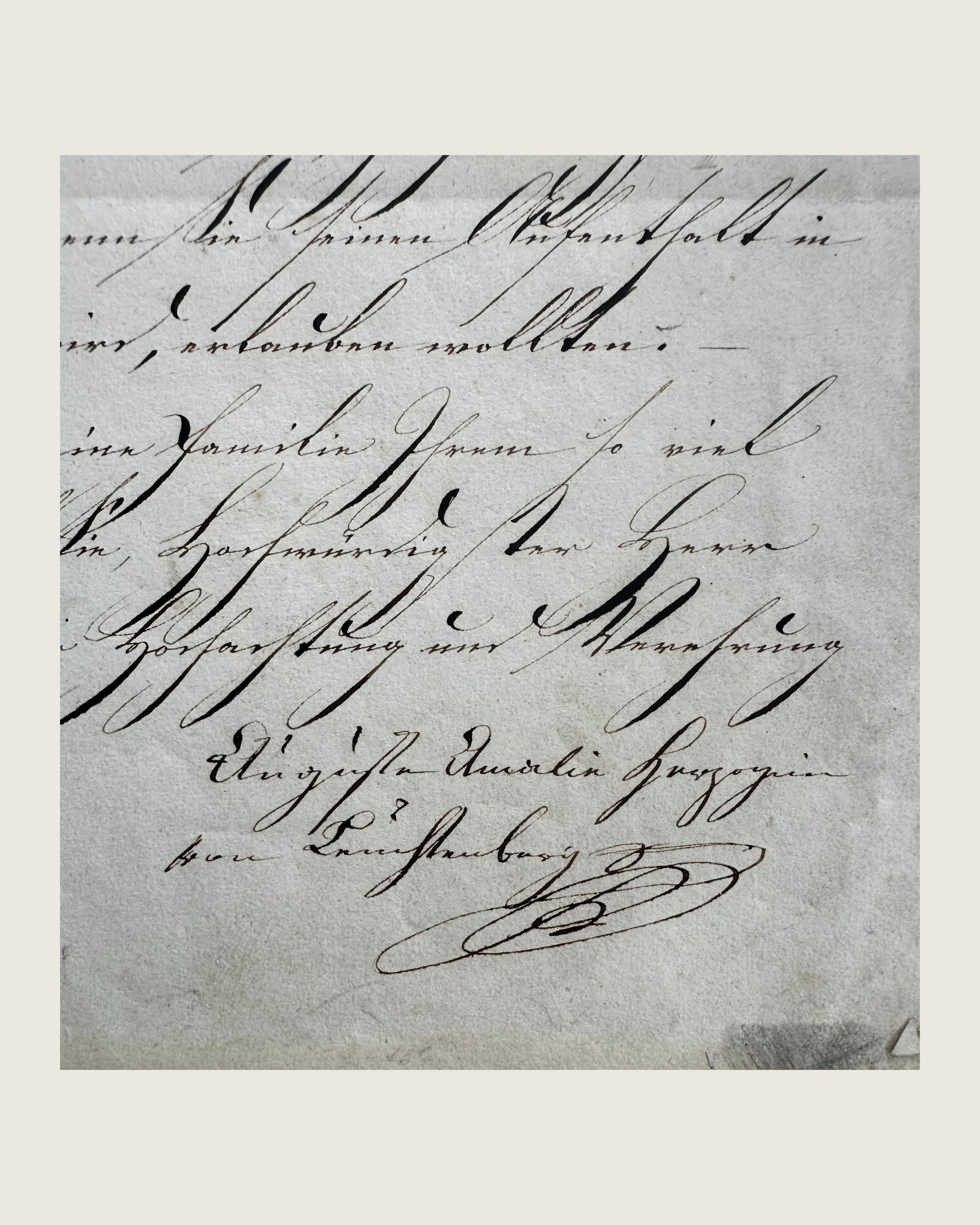 Image 2 of 3
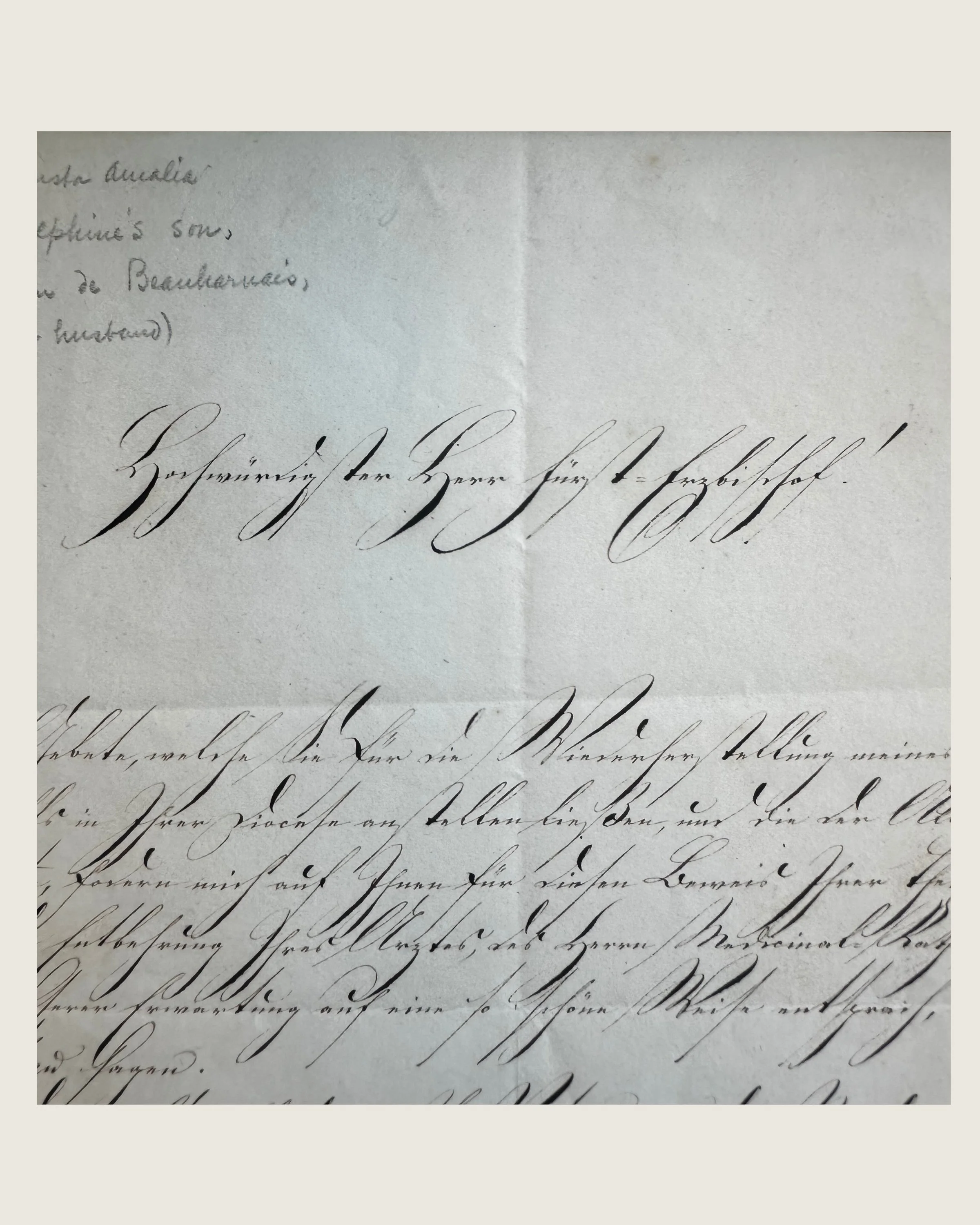 Image 3 of 3
-
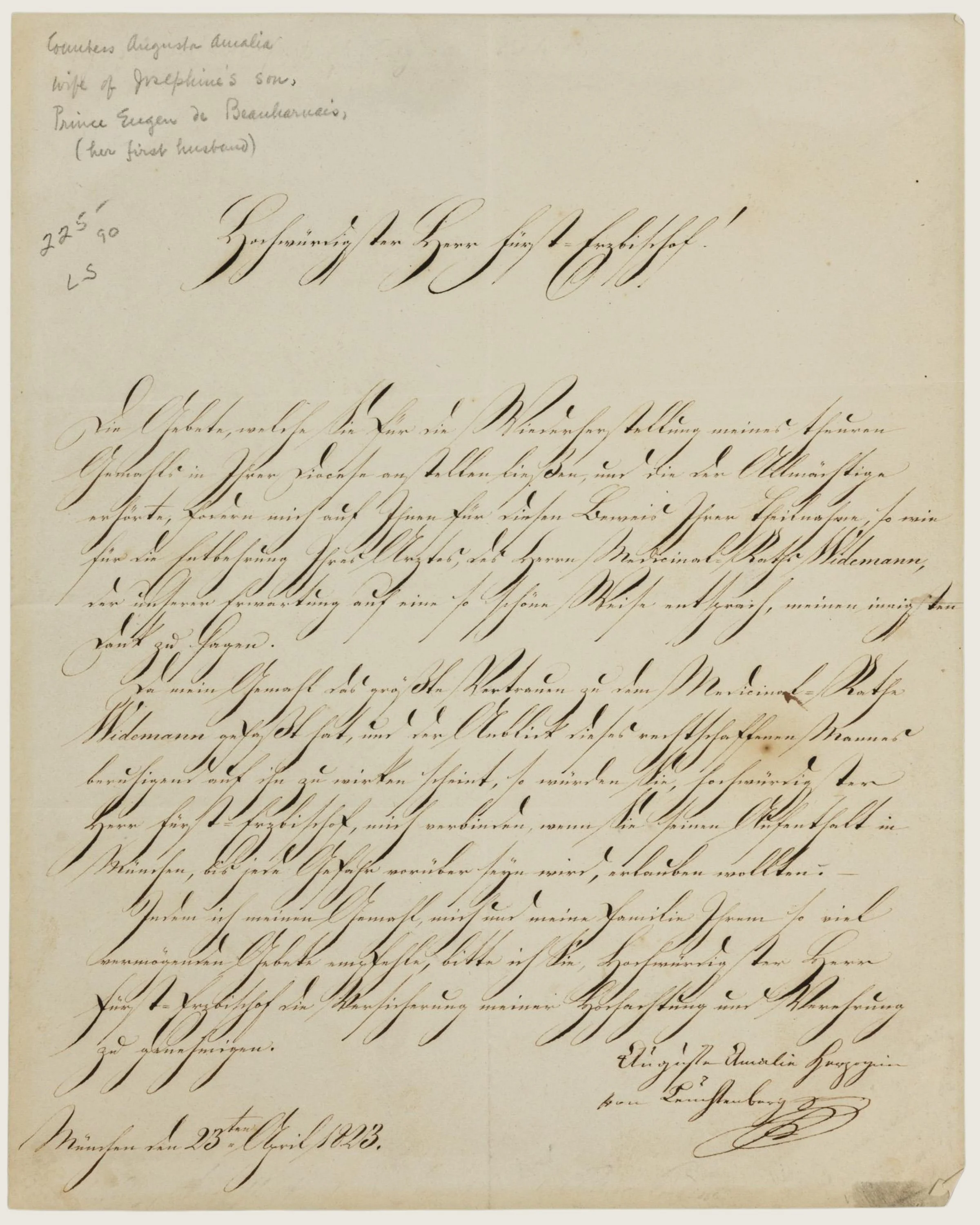
Auguste’s letter was written at the Palais Leuchtenberg in Munich during one of the most serious episodes of her husband’s final illness.
Eugène de Beauharnais had suffered a sudden attack during church on Easter Sunday, 30 March 1823, followed by a second attack on 13 April. Later sources described the episodes as strokes or attacks of apoplexy, although the surviving evidence does not permit a precise modern diagnosis. Auguste wrote this letter on 23 April, only ten days after the second attack.
Her appeal concerned Franz Seraph Amand Widnmann, the physician whom Eugène trusted most. Auguste does not emphasize a particular medicine or treatment. Instead, she records the personal effect of Widnmann’s presence: even seeing this “upright man” appeared to calm her husband.
She therefore asked that Widnmann be allowed to remain in Munich:
“Since my husband has placed the greatest confidence in Medical Councillor Widnmann, and since the sight of this upright man seems to have a calming effect upon him, you would greatly oblige me, Most Reverend Sir, if you would permit his stay in Munich until his fate shall have been decided.”
The phrase is restrained but unmistakable. Auguste did not yet know whether the crisis would end in recovery or death.
Eugène partially recovered and travelled to Marienbad that July with Widnmann. His condition worsened again in the autumn, however, and he died in Munich on 21 February 1824, less than ten months after the letter was written.
-
Auguste Amalie was born into the Bavarian Wittelsbach dynasty in 1788, the daughter of the future King Maximilian I Joseph of Bavaria. Her marriage to Eugène de Beauharnais in 1806 began as an act of Napoleonic diplomacy. Napoleon sought to bind Bavaria more closely to France and to connect the Beauharnais family with an established European royal house.
Auguste reportedly regarded her consent as a sacrifice for her father and country, but the marriage developed into a close and durable partnership. Eugène, the son of Joséphine de Beauharnais and adopted son of Napoleon, served as Viceroy of the Kingdom of Italy before withdrawing to Bavaria after the fall of the French Empire. In 1817 he became Duke of Leuchtenberg and Prince of Eichstätt.
Four of Auguste Amalie and Eugène de Beauharnais’s children entered royal and imperial houses across Europe and South America:
Their daughter Joséphine became Queen of Sweden and Norway.
Their daughter Amélie became Empress of Brazil.
Their son Auguste married Queen Maria II of Portugal.
Their son Maximilian married Grand Duchess Maria Nikolaevna, daughter of Emperor Nicholas I of Russia.
Through these marriages, the descendants of Napoleon’s adopted son and a Bavarian princess became connected with monarchies from Scandinavia to Portugal, Brazil, and imperial Russia.
The letter nevertheless presents Auguste not as an abstract dynastic figure, but as a wife in the middle of a medical emergency. She observed which physician reassured her husband, identified the authority whose cooperation might secure his presence, and appealed directly for him to remain. Her later diary records that she did not leave Eugène for five weeks during the crisis.
-
Franz Seraph Amand Widnmann had served as court physician to the Prince-Bishop of Eichstätt before entering Eugène’s service after the principality was assigned to the Duke of Leuchtenberg. By 1823, he was more than an interchangeable medical attendant. Auguste’s letter shows that Eugène associated him with reassurance and personal security at a moment when his condition appeared life-threatening.
The letter is addressed only to a “Most Reverend Archbishop.” The most likely recipient is Joseph Graf von Stubenberg, Archbishop of Bamberg and continuing Administrator of Eichstätt.
Stubenberg had been Prince-Bishop of Eichstätt before the reorganization of Bavaria’s dioceses. Although appointed Archbishop of Bamberg in 1821, he continued to administer Eichstätt and remained closely connected with the institutions from which Widnmann’s medical career had emerged. This helps explain why Auguste would ask an archbishop to permit or facilitate the physician’s continued stay in Munich.
Lothar Anselm von Gebsattel, Archbishop of Munich and Freising, remains a possible but substantially weaker alternative. No surviving address panel, envelope, registry entry, or recipient’s copy has yet been identified. The recipient should therefore be described as very probably Stubenberg, rather than conclusively identified.
-
The auction catalogue described the manuscript as a signed document, but it is more accurately classified as a letter. It contains a personal request, a formal salutation, and a closing addressed to a particular ecclesiastical recipient.
The letter appears to have been written and signed by Auguste Amalie. The body, closing, and signature present as a coherent manuscript, and the contents fit the historical record with unusual precision: the date falls directly within Eugène’s documented medical crisis; Widnmann was demonstrably involved in his treatment; and the titles, relationships, and institutional circumstances are all historically consistent.
These features support describing the manuscript as an apparently autograph letter signed. They are not, however, equivalent to formal handwriting authentication. An authenticated Auguste letter dated 1 February 1833 is recorded at the Monacensia in Munich and would provide an appropriate comparison for the formation of her name, characteristic capital letters, slant, spacing, and the relationship between the body and signature.
The paper apparently bears a “C. WILMOTT / 1819” watermark. Paper with that maker-and-year combination is documented in European use during the early 1820s and would be chronologically consistent with a letter written in 1823. A watermark dates or identifies the paper, however—not the writing or signature—and the reading should remain provisional until documented through transmitted-light photography.
Nothing in the manuscript’s reported language, date, persons, or circumstances creates an evident anachronism. Its exact autograph status, recipient, watermark reading, and earlier provenance nevertheless remain open to further examination
-
Most Reverend Archbishop,
[Auguste apparently thanks the recipient for his concern, for prayers offered in his diocese, and for his assistance in making Dr. Widnmann available.]
Since my husband has placed the greatest confidence in Medical Councillor Widnmann, and since the sight of this upright man seems to have a calming effect upon him, you would greatly oblige me, Most Reverend Sir, if you would permit his stay in Munich until his fate shall have been decided.
In commending my husband, myself, and my family to your prayer, which is capable of accomplishing so much, I ask you, Most Reverend Sir, to accept the assurance of my esteem and veneration.
Munich, 23 April 1823
Auguste Amalie
Duchess of Leuchtenberg
The opening paragraph has not yet been completely transcribed from the original and is summarized in brackets. The translation preserves the meaning of the recoverable text rather than reproducing every feature of the historical German spelling.