During the English Civil Wars, allegiance could be carried on the body. Small enough to wear or pin, a badge like this declared loyalty to the Crown in a divided kingdom where political symbols were not merely decorative.
This cast and chased silver-gilt badge presents a bare-headed portrait of Charles I with a falling lace collar on one side, and the crowned royal arms within the Garter on the reverse. Its scale is intimate, but its message is not. Portrait, arms, and gilded surface compress monarchy and legitimacy into an object made to be held close.
The badge type is recorded in Medallic Illustrations, vol. I, no. 361/235. This individual specimen is published by Jerome J. Platt as type I, specimen I5 and is documented as a Royalist badge type attributed to T. Rawlins. It survives with a large crack across its upper half—a significant condition issue, plainly disclosed here—while the portrait itself remains intact.
Date: Mid-17th century
Origin: England
Attributed to: Thomas Rawlins, based on published typological comparison; no maker’s mark is identified on the badge.
Material: Cast and chased silver-gilt
Dimensions: 27 × 20 mm
Weight: 2.40 g
Design: Portrait of Charles I on the obverse; crowned royal arms within the Garter on the reverse
Provenance: Noonans Mayfair, Coins and Historical Medals, 10 June 2026, lot 1142; subsequently acquired by the dealer.
Condition: Age-related wear, darkening, and losses to the silver-gilt surface. A large structural crack extends through the upper portion of the badge, with associated distortion and apparent losses along the upper edge. The badge should be handled as fragile. No conservation treatment has been documented.
During the English Civil Wars, allegiance could be carried on the body. Small enough to wear or pin, a badge like this declared loyalty to the Crown in a divided kingdom where political symbols were not merely decorative.
This cast and chased silver-gilt badge presents a bare-headed portrait of Charles I with a falling lace collar on one side, and the crowned royal arms within the Garter on the reverse. Its scale is intimate, but its message is not. Portrait, arms, and gilded surface compress monarchy and legitimacy into an object made to be held close.
The badge type is recorded in Medallic Illustrations, vol. I, no. 361/235. This individual specimen is published by Jerome J. Platt as type I, specimen I5 and is documented as a Royalist badge type attributed to T. Rawlins. It survives with a large crack across its upper half—a significant condition issue, plainly disclosed here—while the portrait itself remains intact.
Date: Mid-17th century
Origin: England
Attributed to: Thomas Rawlins, based on published typological comparison; no maker’s mark is identified on the badge.
Material: Cast and chased silver-gilt
Dimensions: 27 × 20 mm
Weight: 2.40 g
Design: Portrait of Charles I on the obverse; crowned royal arms within the Garter on the reverse
Provenance: Noonans Mayfair, Coins and Historical Medals, 10 June 2026, lot 1142; subsequently acquired by the dealer.
Condition: Age-related wear, darkening, and losses to the silver-gilt surface. A large structural crack extends through the upper portion of the badge, with associated distortion and apparent losses along the upper edge. The badge should be handled as fragile. No conservation treatment has been documented.
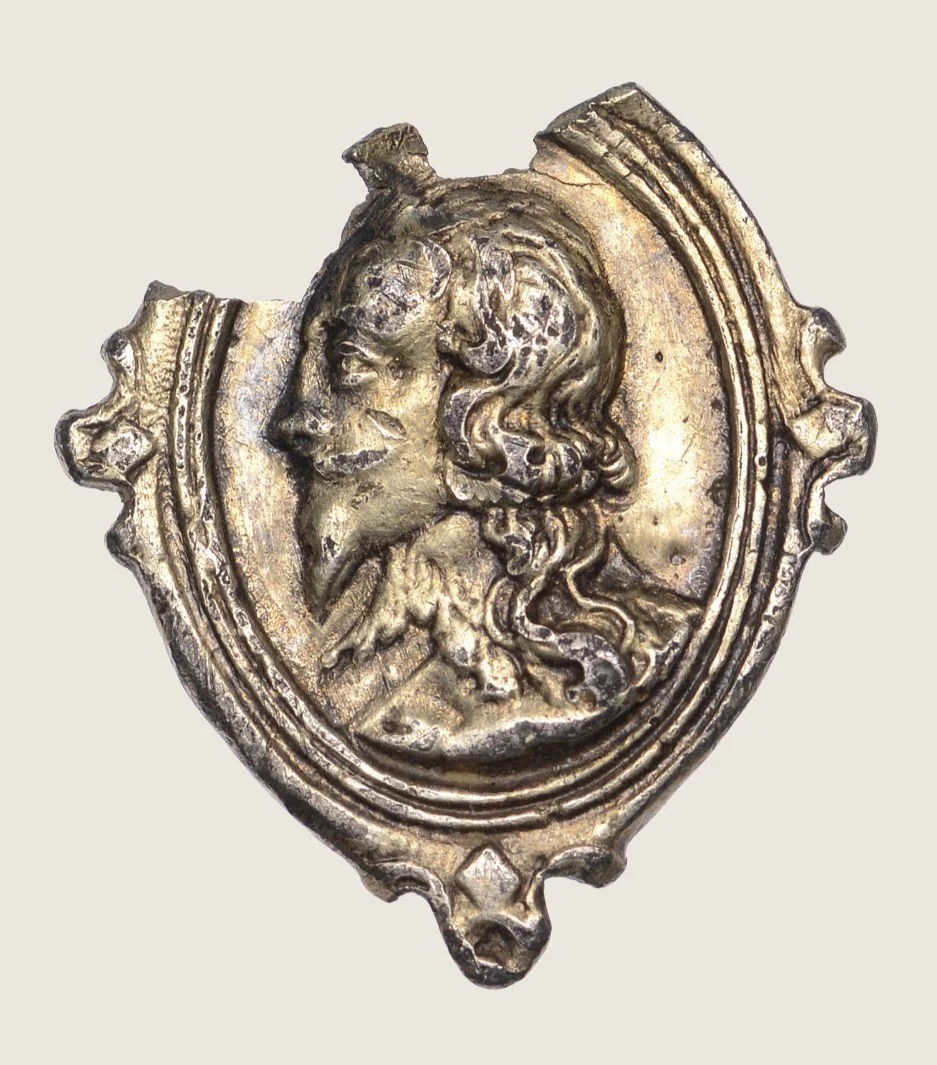 Image 1 of 3
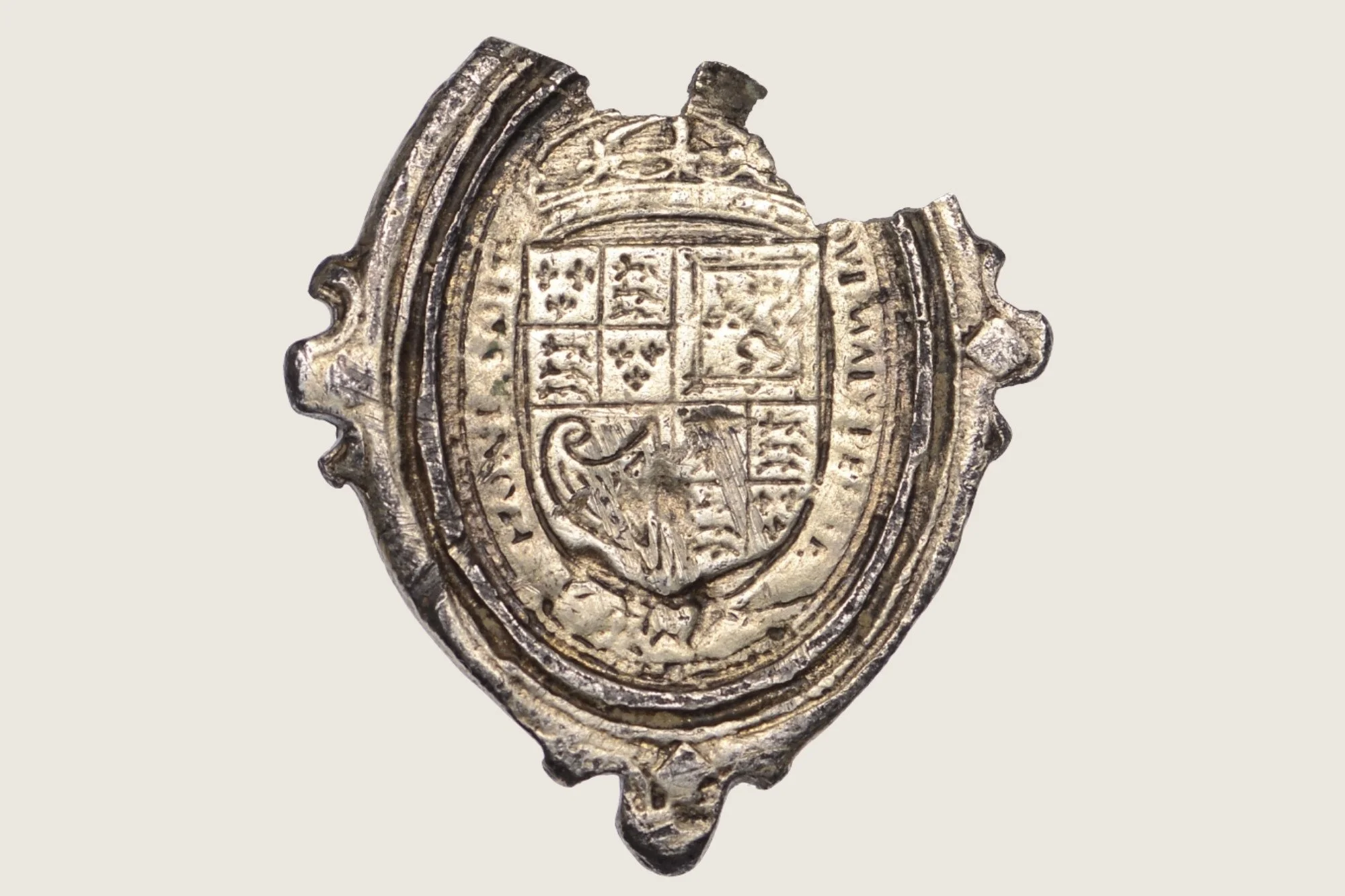 Image 2 of 3
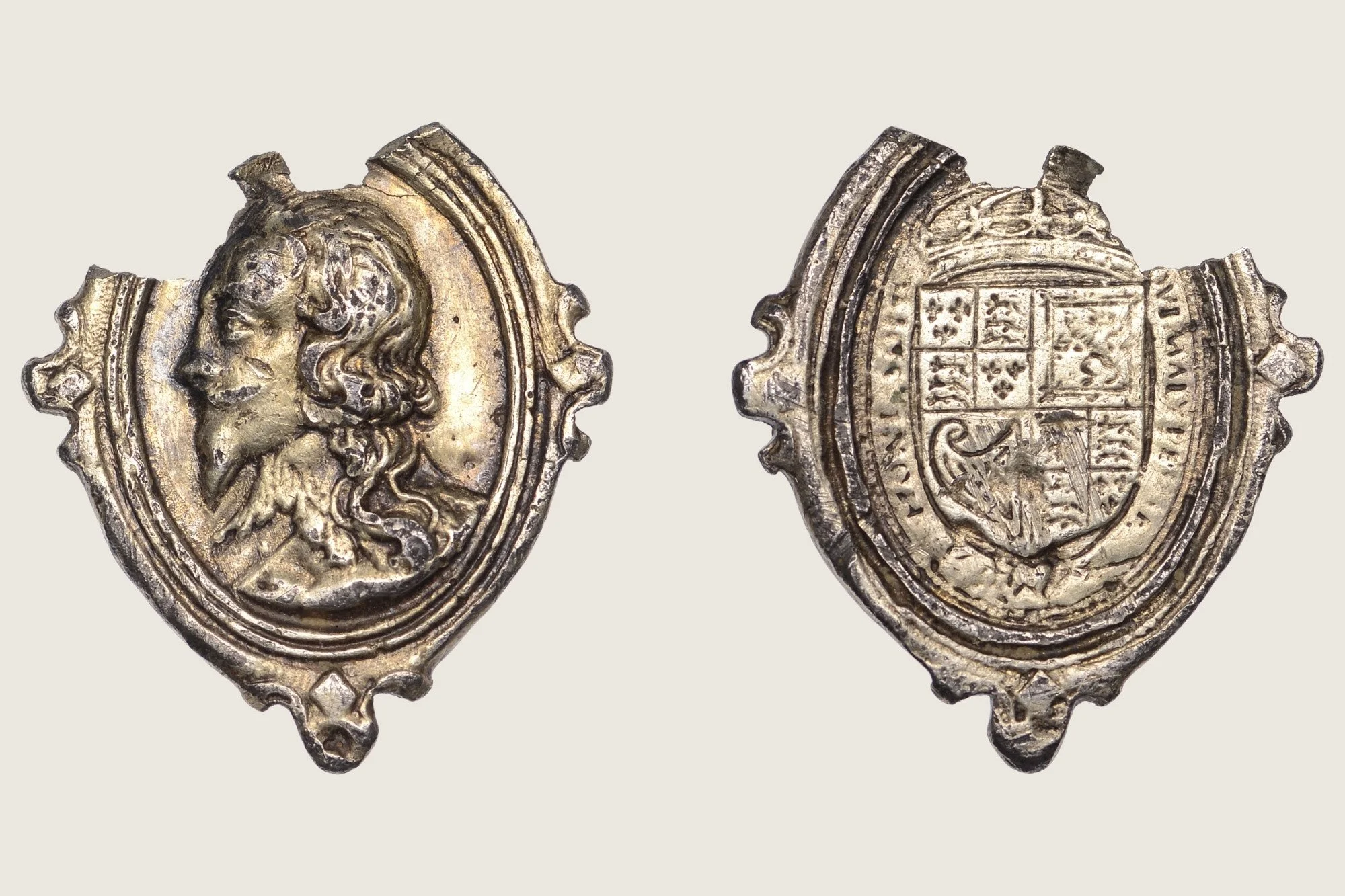 Image 3 of 3