
Objects
Material witnesses to history, carried forward into the present.
An evolving selection of documents and historic objects chosen for their presence, interest, and connection to the people, places, institutions, and moments from which they came.
J. Paul brings together objects from different periods and fields. What connects them is not category, but the fact that they remain direct, physical links to another time. Each is chosen for what it can reveal, evoke, or make newly immediate. Where the record is incomplete, that uncertainty is stated plainly.
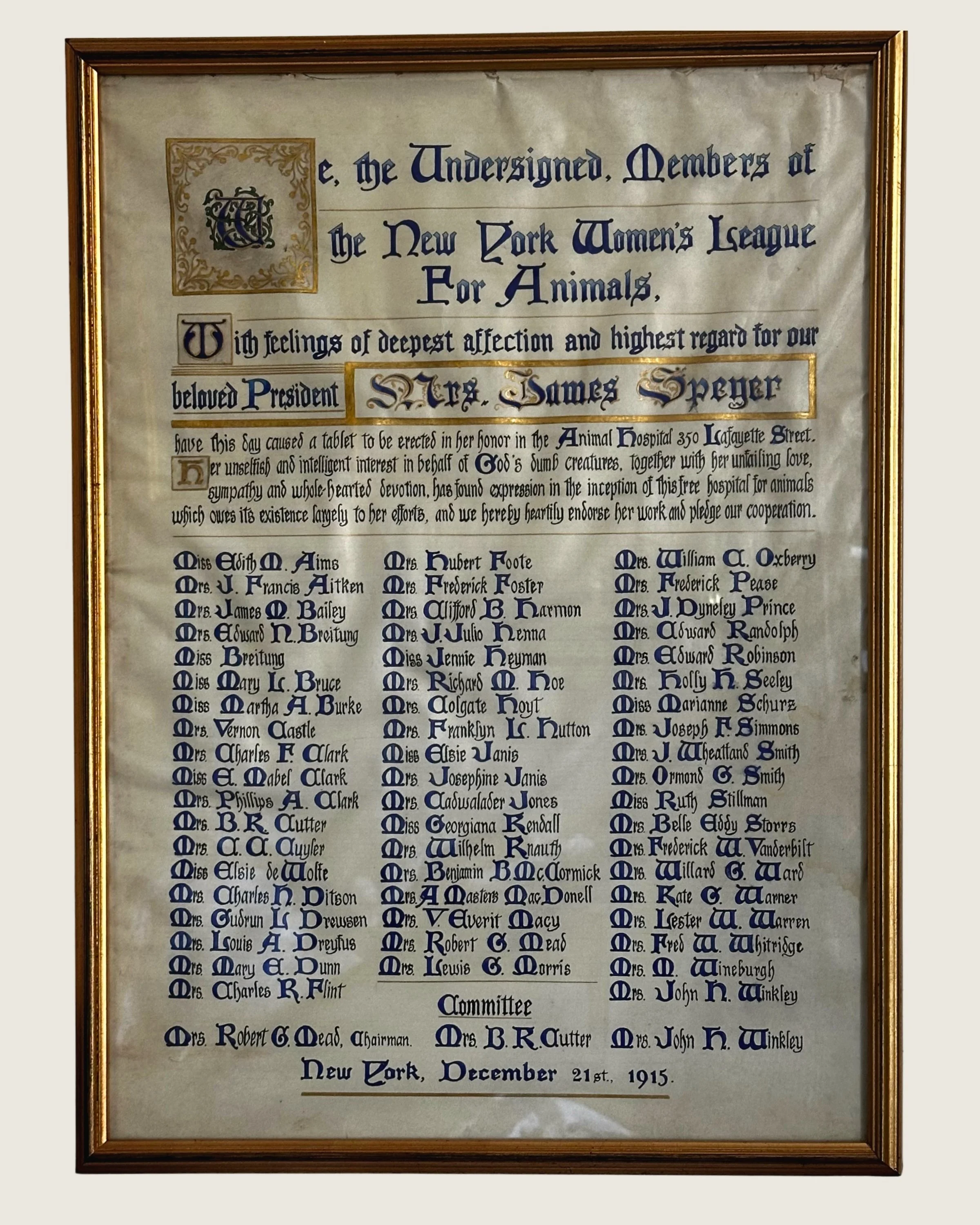
On December 21, 1915, the New York Women’s League for Animals recorded in formal, illuminated script what its members believed their president, Ellin Prince Speyer, had accomplished.
Addressed to Speyer in the contemporary form Mrs. James Speyer, the testimonial states that a tablet had been erected in her honor that day at the League’s Animal Hospital at 350 Lafayette Street. It credits her “love, sympathy and devotion” with finding expression in the creation of the free hospital for animals, which the document says owed its existence largely to her efforts. The members then make a promise of their own: to continue the work she had begun.
The document was created at an important moment in the institution’s history. Speyer had helped establish the independent New York Women’s League for Animals in 1910 and was instrumental in raising funds for its permanent Lafayette Street hospital, which opened in 1914. The organization eventually developed into what is now the Schwarzman Animal Medical Center.
The scale and form of the testimonial match the significance of the occasion. A large decorated initial opens the text, followed by formal lettering and an extensive roster of League members arranged below. Among the names are Elsie de Wolfe, Irene Castle, Elsie Janis, and Louise Holmes Vanderbilt, alongside dozens of other women involved in the organization.
Their presence matters less as a gathering of famous names than as evidence of the network behind the institution. The testimonial records women with social standing, money, organizational reach, and public influence directing those resources toward a practical undertaking: providing medical care for animals in New York.
The names should not presently be understood as a collection of autograph signatures. The document has not been removed from its frame, and the method by which the individual names were applied—whether handwritten, professionally engrossed, printed, or produced through a combination of processes—has not been established.
What survives is both ceremonial and institutional: a tribute to the woman at the center of the League and a contemporary record of the women who pledged to carry its work forward.
Date: December 21, 1915
Place: New York City
Issuing body: New York Women’s League for Animals
Recipient: Mrs. James Speyer — Ellin Leslie Prince Speyer (1849–1921), president of the New York Women’s League for Animals
Document type: Illuminated testimonial or presentation address commemorating the erection of a tablet honoring Speyer at the League’s Animal Hospital
Materials: Paper support with ink and decorative illumination, framed under glass; the support and decorative media have not been independently examined or tested
Dimensions: 17.5 × 23.5 in. (framed)
Provenance: Addressed to Ellin Prince Speyer by the New York Women’s League for Animals in 1915. The subsequent chain of ownership prior to its recent emergence on the market is undocumented; acquired by the dealer in 2026.
Condition: The document remains in the frame in which it was acquired and has not been removed or professionally examined. It shows visible age-related rippling, staining, small tears, and discoloration. The complete edges, reverse, mounting method, backing materials, and any condition concealed by the frame remain unknown. No representation is presently made regarding the archival quality or age of the framing materials. Please review all photographs closely.
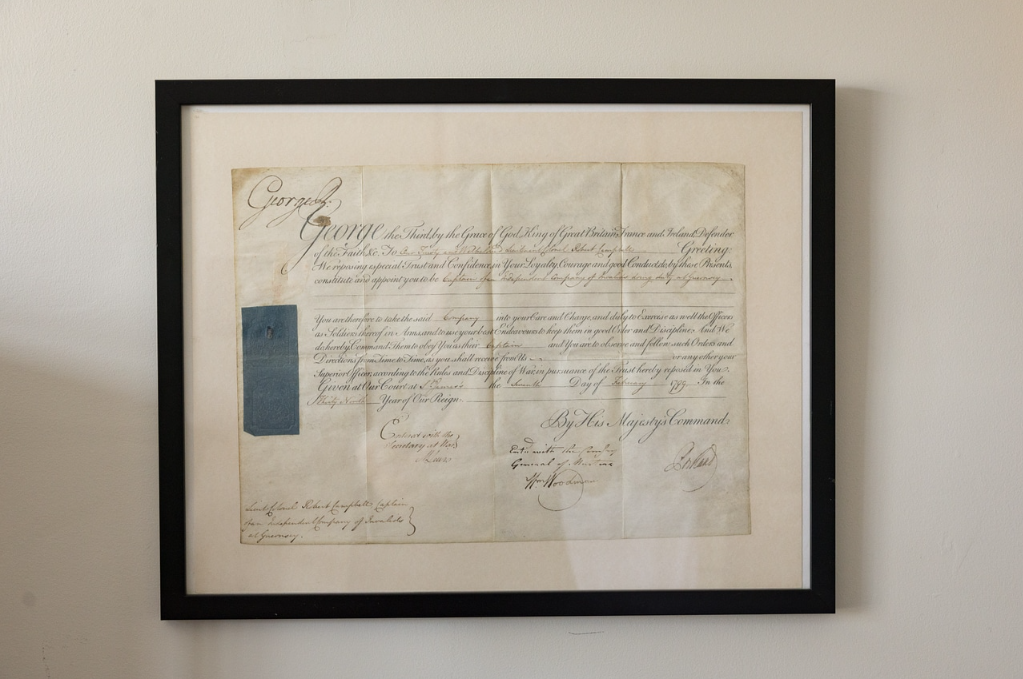
In February 1799, Britain stood deep in the French Revolutionary Wars, bracing for invasion across the Channel. Guernsey sat on the edge of that defensive world: a garrison island closer to France than to London, held within a network of forts, veteran soldiers, and administrative authority.
This commission appoints Lieutenant-Colonel Robert Campbell to command an Independent Company of Invalids at Guernsey. In the language of the period, “Invalids” were veteran soldiers assigned to strategic garrison service, freeing younger troops for active campaigns. The document carries the royal sign manual of George III and is countersigned by the Duke of Portland, then Home Secretary.
Its significance is not only in the names it bears. Paper, seal, official signatures, folds, and endorsements show how Crown authority moved from the sovereign’s office through the state to a military post on an exposed island. It survives as an instrument of appointment, but also as a physical record of the machinery that made an empire govern.
Date: 7 February 1799
Origin: Great Britain, reign of George III
Named officer: Lieutenant-Colonel Robert Campbell
Material: Printed and manuscript document on paper with blue revenue stamp panel; later frame
Dimensions: Document 11.5 × 15.5 in.; frame 20¾ × 16½ in.
Provenance: Diederich Auction Gallery, Fine Antiques and Estates Timed Auction Featuring the Living Estate of Joy Yudofsky, 10 May 2026, lot 102; subsequently acquired by the dealer.
Condition: Expected folds, handling wear, scattered toning and staining, and localized fading; most of the text remains legible. The commission has not been examined outside its frame. Its complete margins, reverse, mounting method and any condition concealed by the frame remain unknown. No representation is presently made regarding the archival quality of the mounting or backing materials.
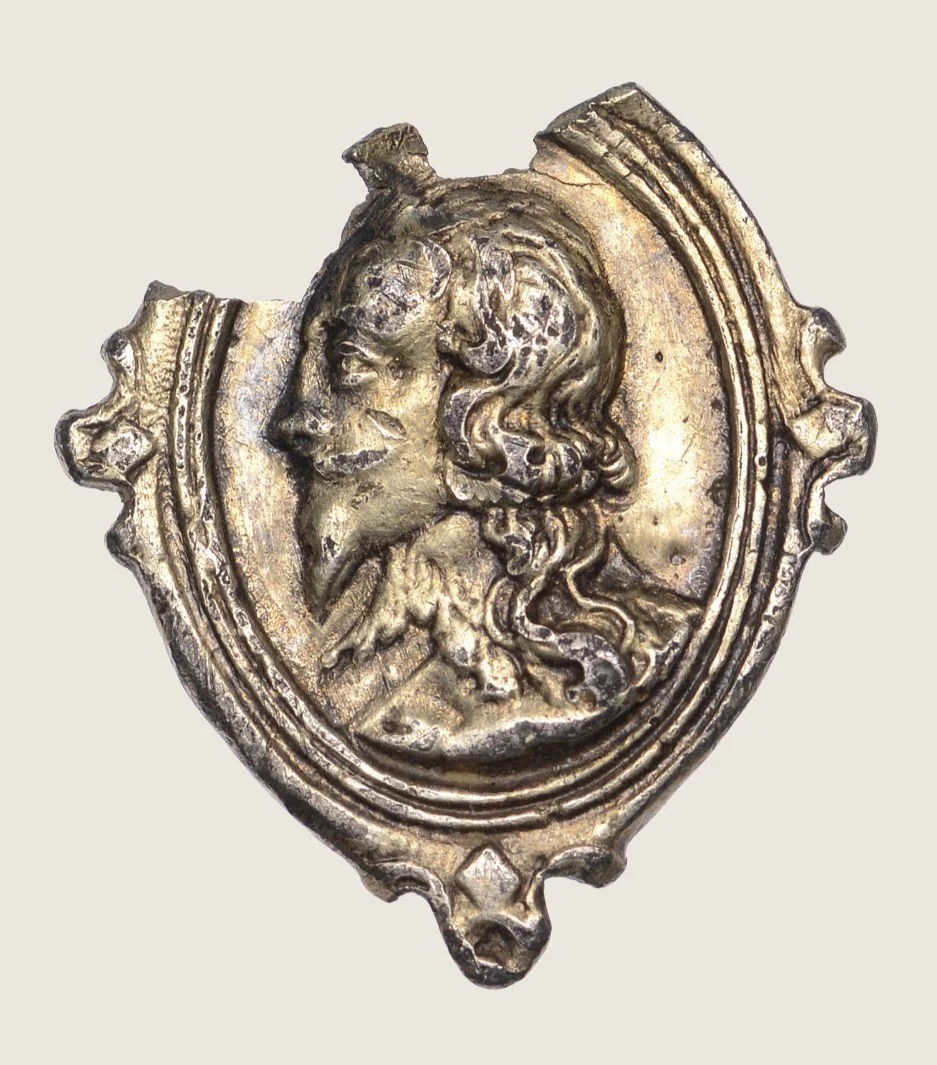
During the English Civil Wars, allegiance could be carried on the body. Small enough to wear or pin, a badge like this declared loyalty to the Crown in a divided kingdom where political symbols were not merely decorative.
This cast and chased silver-gilt badge presents a bare-headed portrait of Charles I with a falling lace collar on one side, and the crowned royal arms within the Garter on the reverse. Its scale is intimate, but its message is not. Portrait, arms, and gilded surface compress monarchy and legitimacy into an object made to be held close.
The badge type is recorded in Medallic Illustrations, vol. I, no. 361/235. This individual specimen is published by Jerome J. Platt as type I, specimen I5 and is documented as a Royalist badge type attributed to T. Rawlins. It survives with a large crack across its upper half—a significant condition issue, plainly disclosed here—while the portrait itself remains intact.
Date: Mid-17th century
Origin: England
Attributed to: Thomas Rawlins, based on published typological comparison; no maker’s mark is identified on the badge.
Material: Cast and chased silver-gilt
Dimensions: 27 × 20 mm
Weight: 2.40 g
Design: Portrait of Charles I on the obverse; crowned royal arms within the Garter on the reverse
Provenance: Noonans Mayfair, Coins and Historical Medals, 10 June 2026, lot 1142; subsequently acquired by the dealer.
Condition: Age-related wear, darkening, and losses to the silver-gilt surface. A large structural crack extends through the upper portion of the badge, with associated distortion and apparent losses along the upper edge. The badge should be handled as fragile. No conservation treatment has been documented.
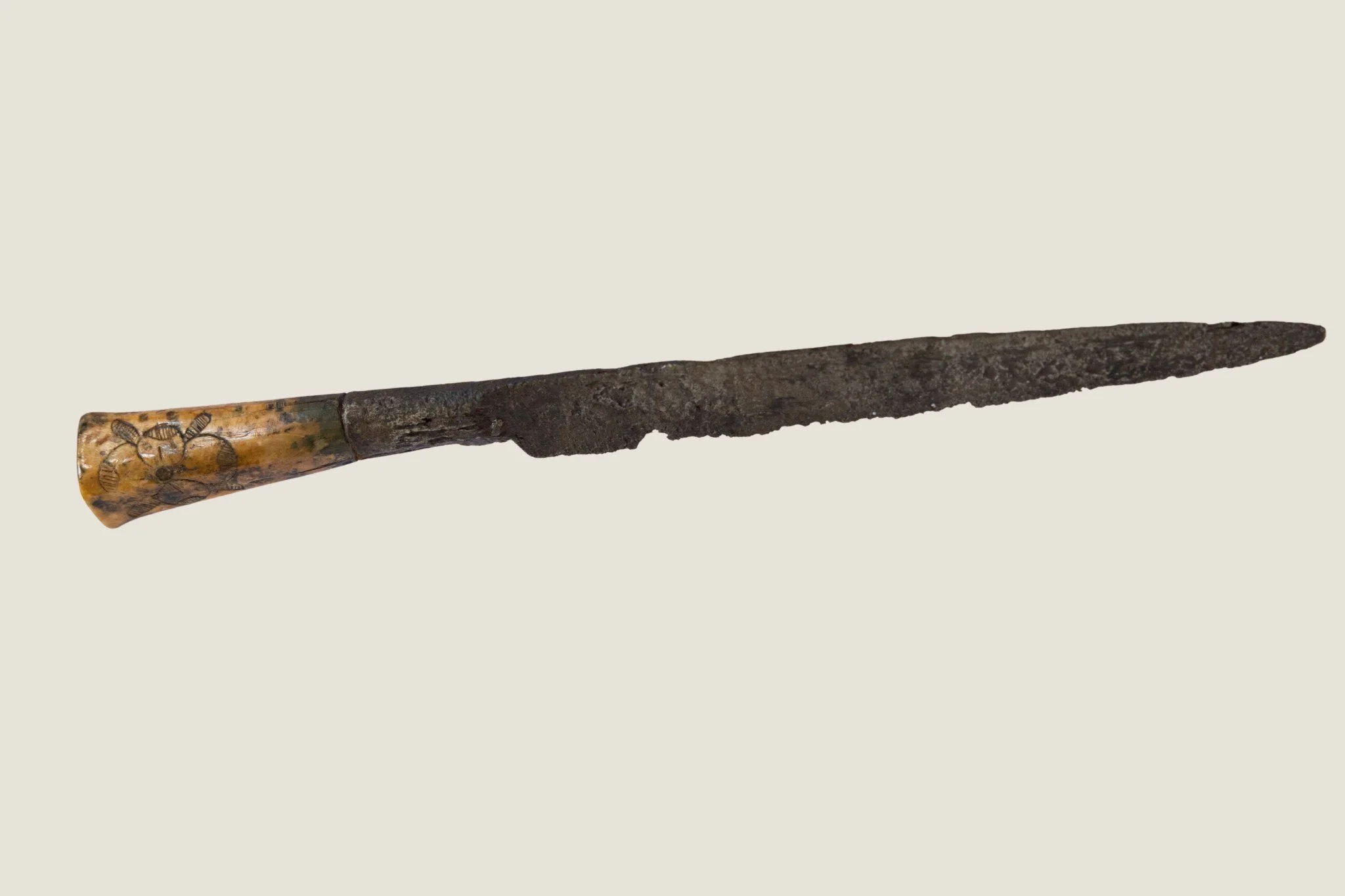
This iron knife was made for practical use. Its blade was sharpened and worked; its pale animal-bone handle was carved with a repeating geometric pattern that gave an everyday tool a degree of care and individuality.
The blade survives dark with age, while the handle retains its lozenge-section form and incised quatrefoil decoration. The handle is bovine bone, and the blade and handle are original to one another. A prior catalogue dated the knife to the seventeenth century and identified it as English or British; that dating and regional attribution remain unconfirmed.
That is part of its appeal. Seventeenth-century domestic tools often disappeared through use, loss, and replacement. This one remained. The worn iron, carved handle, and accumulated irregularities preserve the evidence of a long working life.
Date: 17th century, according to prior catalogue attribution; unconfirmed
Origin: English or British, according to prior catalogue attribution; unconfirmed
Maker / Markings: No maker’s mark recorded
Materials: Iron blade with carved bovine-bone handle; blade and handle original to one another.
Dimensions: Approximately 7¾ in. / 19.8 cm
Weight: 31.8 g
Provenance: Acquired on the UK art market before 2000; property of an Essex, UK, gentleman; TimeLine Auctions, Antiquities Sale — Day 4, 5 June 2026, lot 2300; subsequently acquired by the dealer. The pre-2000 history is recorded from the auction catalogue and has not been independently verified.
Exhibition history: Displayed at Harwich Museum from March 4 through June 7, 2026. A photograph of the object on display accompanies the sale.
Condition: Heavy overall stable corrosion and pitting to the iron blade, with substantial edge irregularity and material loss. Wear and oxidation extend across the blade surface, but the corrosion is stable. The carved bovine-bone handle shows staining, discoloration, handling wear, and minor surface irregularities. Please review all photographs closely.
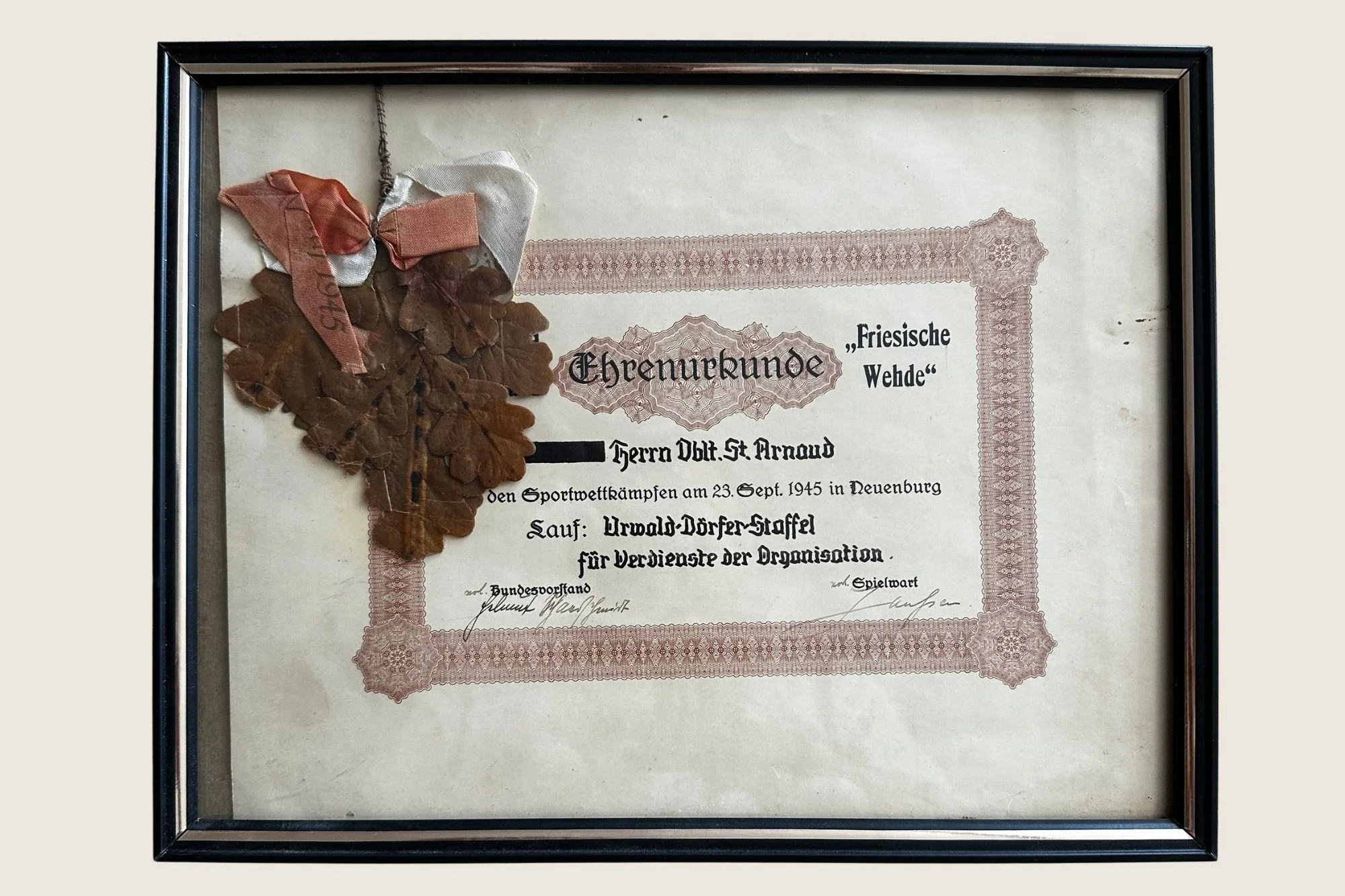
On September 23, 1945, less than five months after Germany’s surrender, a German sporting association in Neuenburg, Oldenburg, held its traditional Urwaldlauf under Allied occupation.
This two-piece presentation group records the part played by Lieutenant St-Arnaud, described by the association as the sports officer of the Allied occupation troops in Neuenburg. The larger document is an honorary certificate recognizing his contribution to organizing the Urwald Villages Relay. Mounted with it are a faded winner’s ribbon and a cluster of preserved oak leaves, with “1945” still visible on one ribbon tail.
Sixteen days later, on October 9, the Turn- und Sportbund “Friesische Wehde” formally thanked St-Arnaud for his generous assistance. The accompanying letter explains that the ribbon was ordinarily presented only to athletes for outstanding performance. Here, it was given instead as a visible mark of gratitude.
The letter closes with a hope that “peaceful sporting competition” would further strengthen relations between the Allied occupation army and local German sportsmen. That language gives the group its particular historical force. This is not a battlefield award or military decoration, but a record of what followed the fighting: an occupying officer, a local civilian association, and the tentative restoration of public life only months after the end of the war.
The recipient is attributed with high confidence to George F. St-Arnaud (1921–2009), a Canadian Second World War veteran who later had a long career with Johnson & Johnson. The attribution is supported by the Quebec provenance of the group and by additional St-Arnaud material reportedly offered alongside it. His exact wartime unit remains unconfirmed.
The letter directly documents the certificate and ribbon as elements of the presentation. The ribbon survives tied into an oak-leaf spray, and the physical construction and survival of the elements together strongly support the leaves as part of the original winner’s presentation. The date and arrangement of the present framing remain undocumented.
Date: September 23 and October 9, 1945
Place: Neuenburg in Oldenburg, Germany
Issuing body: Turn- und Sportbund “Friesische Wehde”
Recipient: Lieutenant St-Arnaud, attributed with high confidence to George F. St-Arnaud (1921–2009)
Materials: Two paper documents; textile winner’s ribbon; preserved oak leaves; later or undated black frames
Dimensions: Letter frame: 8.25 × 10.25 in.; certificate frame: 13 × 10.25 in.
Provenance: Purchased from Galerie Pomme Grenade/Pomegranate in North Hatley, Quebec, where the documents were offered with additional material relating to George F. St-Arnaud. The earlier family or estate chain is not documented.
Condition: Both documents remain in the frames in which acquired and have not been examined out of frame. The certificate shows toning, folds, spotting, minor tears, surface wear, and a dark rectangular strip physically present over part of the recipient line; its original purpose is unknown. The ribbon is faded, creased, frayed, and locally stained. The oak leaves are heavily dried, brittle, cracked, and subject to small losses. The letter shows pronounced toning, extensive folding and creasing, upper-edge tears and losses, staining, edge wear, and general brittleness. The frames show surface wear and are not established as contemporary with the documents. Please review all photographs closely.
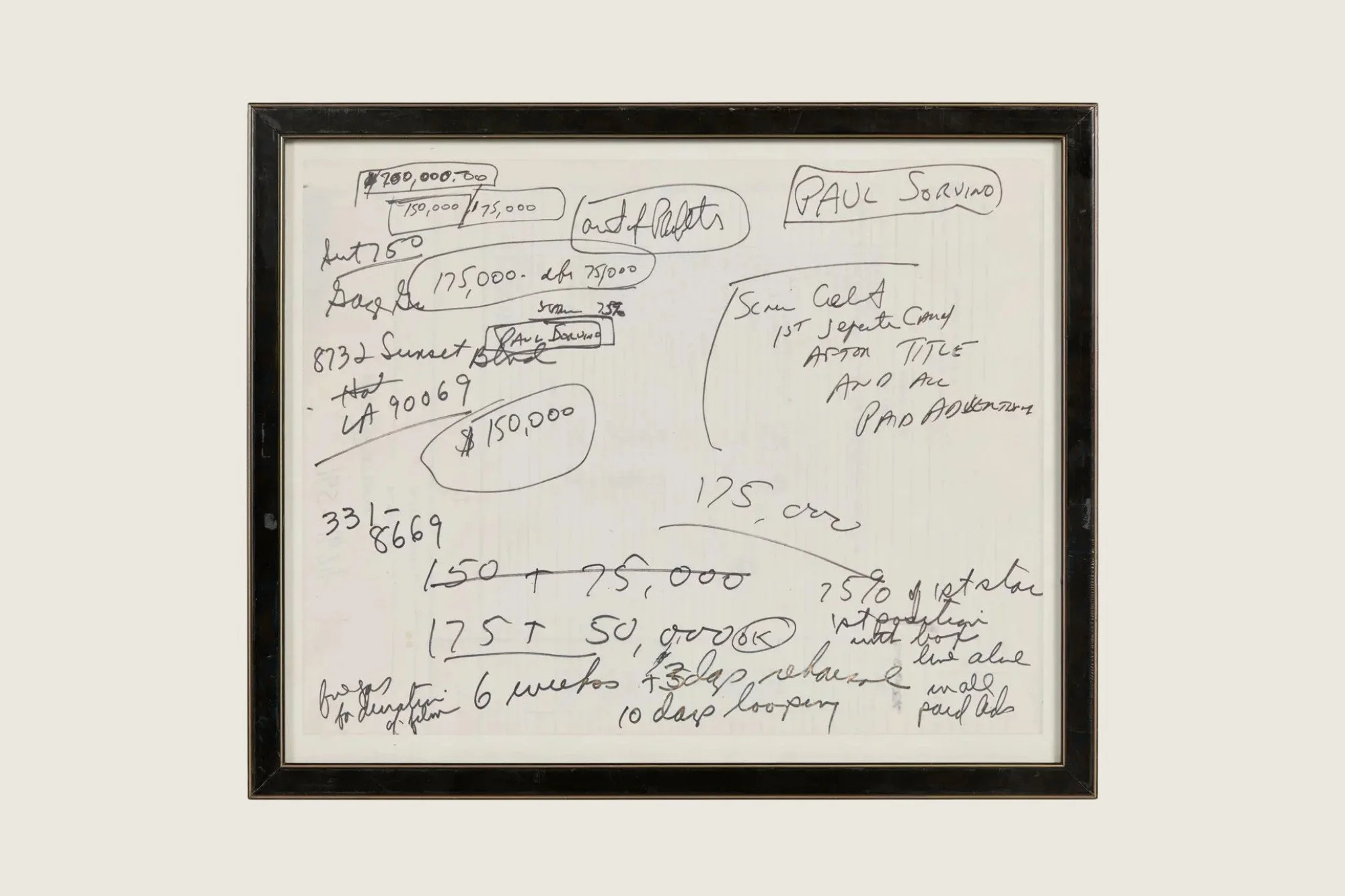
A deal-point sheet is not a script, poster, or prop. It is where a production begins to take shape in practical terms: money, credit, participation, negotiation, and the private arithmetic behind a finished film.
This framed handwritten sheet attributed to Jerry Weintraub outlines terms relating to Paul Sorvino’s participation in Cruising, the 1980 United Artists film directed by William Friedkin. Dense with figures, revisions, circled notes, and working shorthand, it preserves the texture of a producer’s process before terms were formalized in contracts. The relationship between these proposed terms and Sorvino’s final contractual arrangement remains unknown.
Julien’s Auctions offered the sheet as part of material from the estate of producer Jerry Weintraub. Its authorship is attributed to Weintraub on that basis; J. Paul has not conducted an independent handwriting authentication.
Cruising became one of the most debated American films of its era. Its production and release generated protest, controversy, censorship disputes, and lasting discussion about representation, urban culture, and the film’s depiction of New York’s leather-bar scene.
The object is not fan memorabilia in the usual sense. It is a working business document from the machinery behind a film that became a cultural flashpoint.
Date: c. 1979–1980; the sheet itself is undated
Origin: United States; United Artists / Jerry Weintraub production
Attributed to: Jerry Weintraub, based on its inclusion in the Weintraub estate material offered by Julien’s Auctions; the handwriting has not been independently authenticated.
Subject: Paul Sorvino’s participation in Cruising
Material: Handwritten ink on paper, framed
Dimensions: Visible paper 8.5 × 11 in.; frame 15.5 × 12 in.
Provenance: Estate of Jerry Weintraub; offered by Julien’s Auctions in May 2026 as Lot 204 and acquired there by the dealer.
Condition: Presented in a later black frame and not examined out of frame. The sheet appears flat and is not folded. No tears, losses, or other damage are visible through the glazing.
The handwritten deal-point notes are written on the reverse of what appears to be a studio or production-related form. Because the sheet has not been removed from the frame, the full edges, mounting method, and any portions concealed by the frame or mat have not been inspected.
Please review all photographs closely. Additional photographs are available upon request.
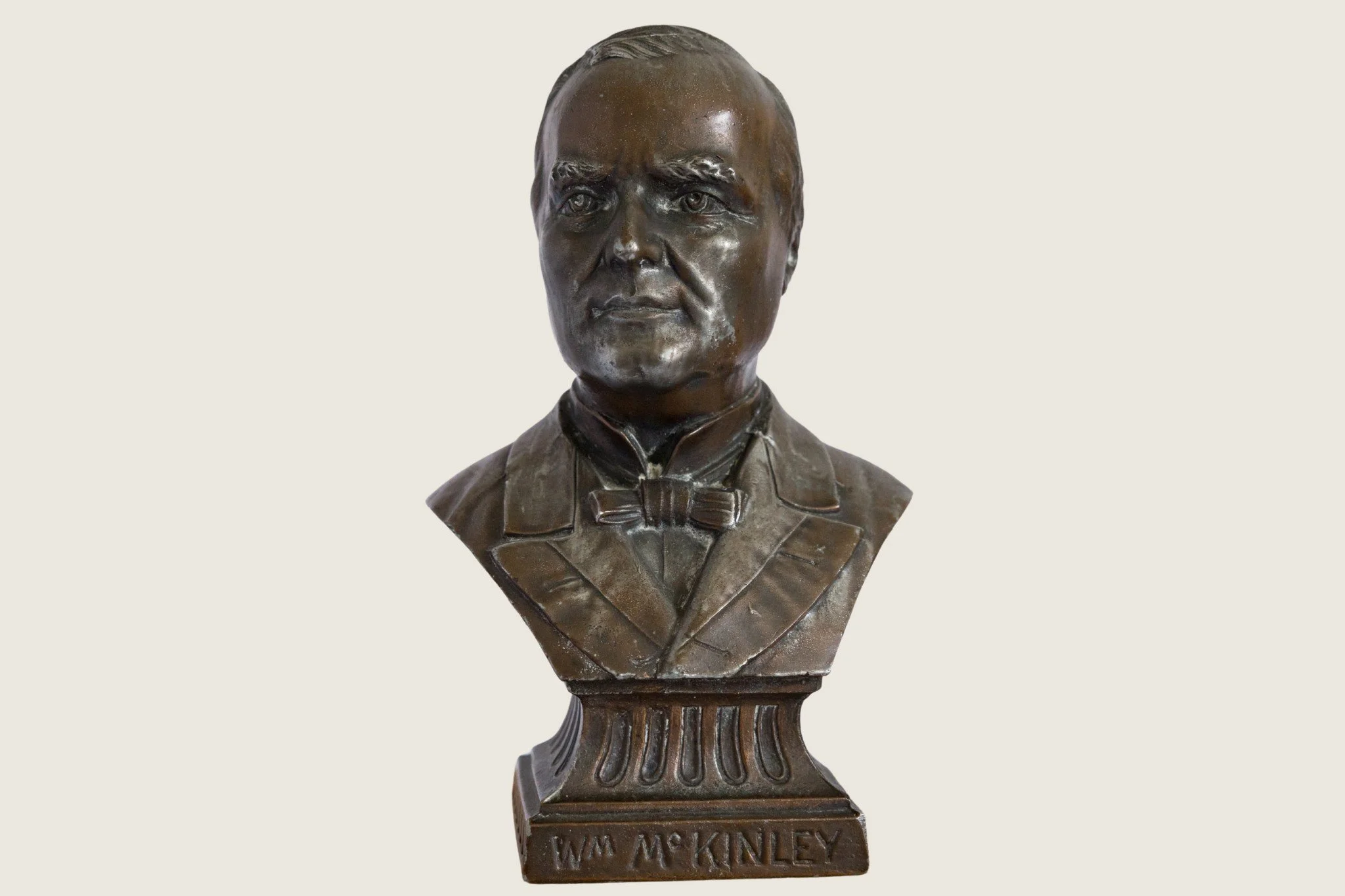
In 1896, presidential campaigns entered American homes through objects as much as through speeches, newspapers, and rallies. Buttons, ribbons, canes, plaques, and portrait busts gave voters a way to place a candidate’s image in offices, shops, and private rooms.
This hollow-cast bust of William McKinley belongs to that world. This bust presents McKinley in formal dress on a classically fluted pedestal, with “WM McKINLEY” cast across the front. The side carries an integral mark: “COPYRIGHT BY N.N.S. & CO. 1896 / 2238 / N.Y.” 1896 was the year of McKinley’s first presidential campaign. The mark securely dates the model or design. It does not, by itself, establish the casting date of this particular example.
The 1896 copyright places the model within the visual culture of McKinley’s first presidential campaign, although the production date and original purpose of this particular casting remain unconfirmed. The 1896 campaign set McKinley against William Jennings Bryan in one of the defining political contests of the Gilded Age. Whatever the casting date of this particular example, the copyrighted model belongs to the visual culture of McKinley’s 1896 candidacy, when his political identity was being carried into everyday American spaces.
Date: Copyrighted 1896. The construction and surviving bronzed surface are consistent with an early casting, but the present record does not establish whether this example was made during the 1896 campaign or at a later date from the copyrighted model.
Origin: United States
Maker / Markings: N.N.S. & Co., New York; model no. 2238; 1896 copyright cast into the model
Material: Hollow-cast white metal, probably a spelter or zinc-rich alloy, with bronzed finish; alloy untested.
Dimensions: 7.25 in. high; base 2.25 in. deep × 2⅞ in. wide; shoulders 4.5 in. wide
Weight: 666.2 g
Form: Political portrait display bust; campaign-era production plausible but unconfirmed
Provenance: Purchased in person by the dealer at the Stratford Antique Center, Stratford, Connecticut, in June, 2026. Earlier ownership history is not documented.
Condition: Surface wear, uneven darkening, patina, and finish loss consistent with age. A small hole is present at the rear crown. The alloy has not been tested. Please review all photographs closely for surface condition, casting, and underside detail.
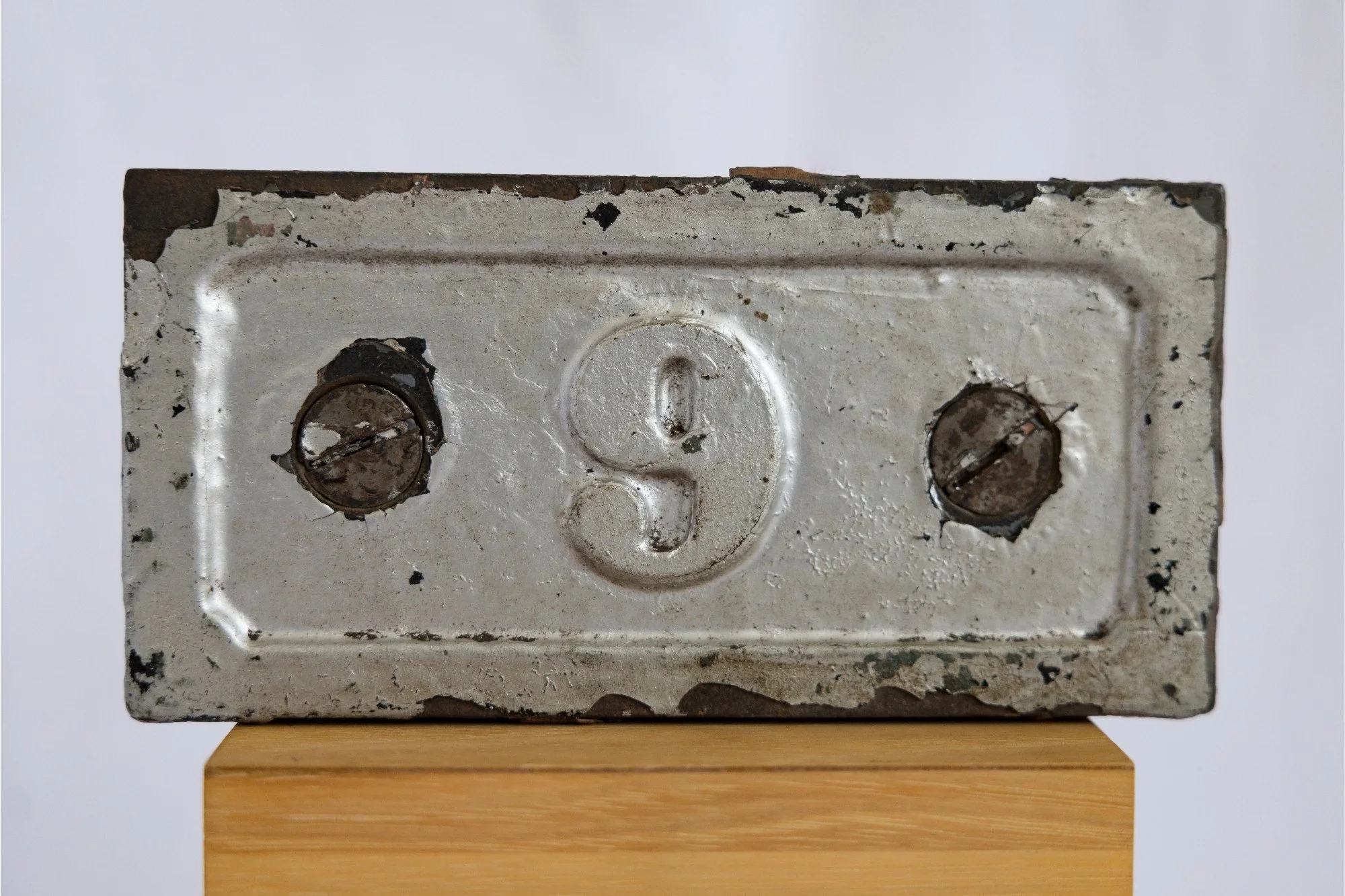
At 65 State Street in Windsor, Vermont, the original Vermont State Prison opened in 1809 and grew through major expansions in 1830, 1882, and 1928. By the time the original prison closed in 1975, it contained 352 cells and was described as the oldest state prison in continuous operation in the United States.
This heavy cast-iron component is marked with a raised “9” and is accompanied by an identification tag attributing it to Windsor State Prison and dating it to the late nineteenth century. Its construction is far more substantial than a simple door number: the body is deeply cast and hollowed within, with slotted screws, internal channels, and dedicated bolt spaces designed to fasten it to iron bars or a related barred assembly.
That construction makes an ordinary cell-door number plate unlikely. The strongest reading is that it formed part of a larger cell-block identification system.
Although its exact original function remains unconfirmed, what survives is the material logic of confinement: weight, old paint, corrosion, engineered openings, and a number used to impose order within a larger controlled environment.
The accompanying tag attributes the object to Windsor State Prison and dates it to the late nineteenth century. No independent institutional, architectural, or collection record presently confirms that attribution.
Date: Late 19th century, as identified on accompanying tag
Attributed to: Windsor State Prison, Windsor, Vermont, as identified on accompanying tag; earlier ownership history undocumented
Material: Cast iron with remnants of painted surface
Dimensions: 6.5 in. long × 3.25 in. high × 1.75 in. deep
Weight: 2,035 g / 4.48 lbs
Marking: Raised numeral “9”
Probable function: Numbered component from a substantial barred, gate, cell-block, or locking assembly; exact function unresolved
Provenance: Purchased in person by the dealer at the Champlain Valley Antique Center, Shelburne, Vermont, in June, 2026, with a surviving tag attributing the object to Windsor State Prison. Earlier ownership and the circumstances of its removal from the prison are not documented.
Condition: Wear, rust, scuffs, paint loss, and surface irregularity are consistent with age and use. The interior and edges show dark metal and corrosion. Please review all photographs closely for construction, mounting points, and surface condition.
On 23 April 1823, Auguste Amalie of Bavaria wrote from Munich during a genuine medical crisis. Her husband, Eugène de Beauharnais—Duke of Leuchtenberg, son of Joséphine, adopted son of Napoleon, and former Viceroy of Italy—had suffered two severe attacks within the preceding weeks. Auguste appealed to an unnamed archbishop to allow Eugène’s trusted physician, Franz Seraph Amand Widnmann, to remain in Munich.
Her reason was intimate rather than ceremonial. Eugène had placed the greatest confidence in Widnmann, she explained, and even the sight of the physician appeared to calm him. She asked that he be permitted to stay “until his fate shall have been decided” and commended her husband, herself, and their family to the archbishop’s prayers.
The letter was written only ten days after Eugène’s second reported apoplectic or stroke-like attack. Although he recovered sufficiently to travel to Marienbad later that summer, his condition deteriorated again, and he died in Munich on 21 February 1824.
Auguste was herself an important dynastic figure in post-Napoleonic Europe. A daughter of King Maximilian I Joseph of Bavaria, her marriage to Eugène joined the Wittelsbach dynasty to the family of Joséphine de Beauharnais and Napoleon’s adopted son. Their children later entered royal and imperial houses across Europe and beyond: Joséphine became Queen of Sweden and Norway; Amélie became Empress of Brazil; their son Auguste married Queen Maria II of Portugal; and Maximilian married Grand Duchess Maria Nikolaevna, daughter of Emperor Nicholas I of Russia.
The recipient is not named in the surviving text. The strongest candidate is Joseph Graf von Stubenberg, Archbishop of Bamberg and continuing Administrator of Eichstätt. His unusual position connects the Leuchtenberg household, the former episcopal establishment at Eichstätt, and Widnmann’s earlier service there. The identification is highly persuasive but remains unconfirmed.
The manuscript appears to have been both written and signed by Auguste Amalie. That assessment is supported by its visual presentation and by the unusually exact correspondence between its date, language, titles, named physician, and Eugène’s documented medical crisis. Formal comparison with an authenticated example of Auguste’s handwriting has not yet been completed, so the description apparently autograph letter signed remains provisional rather than absolute.
Date: 23 April 1823
Origin: Munich, Kingdom of Bavaria
Writer: Auguste Amalie of Bavaria, Duchess of Leuchtenberg and Princess of Eichstätt
Recipient: An unnamed archbishop, very probably Joseph Graf von Stubenberg, Archbishop of Bamberg and Administrator of Eichstätt; unconfirmed
Subject: The grave illness of Eugène de Beauharnais and the continued attendance of his physician, Franz Seraph Amand Widnmann
Language: German
Material: Manuscript in ink on paper
Dimensions: 9.25 inches (H) x 7.25 inches (W)
Hand and signature: Apparently written and signed by Auguste Amalie. The body and signature appear visually compatible with an autograph letter, while the contents correspond closely with the documented circumstances of Eugène’s illness. Formal comparison with an authenticated example of her handwriting has not yet been completed.
Watermark: Apparently “C. WILMOTT/ 1819”
Provenance: Goldberg Coins & Collectibles, Goldberg Winter Collectibles Auction, 25 February 2026, lot 1592, catalogued as “Amalia Augusta of Bavaria, Duchess of Leuchtenberg – Signed Document (1823),” where it was unsold; reoffered by Goldberg Coins & Collectibles in The Summer Collectibles Auction, 15 July 2026, lot 23; subsequently acquired by the dealer.
Condition: Single folded manuscript sheet with general toning, old horizontal and vertical folds, handling wear, minor edge irregularities, and a small defect or bend near the lower-right corner. Later pencil identification and inventory or price notations appear at the upper left.